5 Important Estate Planning Documents Every Illinois Adult Should Know About
November 11, 2026
Illinois Estate Planning Series — Article 4 of 5
When people hear the words "estate planning," they often think about writing a will and deciding who will inherit their property.
But estate planning involves much more than determining what happens after you die.
What happens if you're seriously injured, become ill, or are temporarily unable to make important decisions for yourself?
Who will pay your bills? Who will communicate with your doctors? And who will make decisions about your medical care?
These are questions that estate planning can help address.
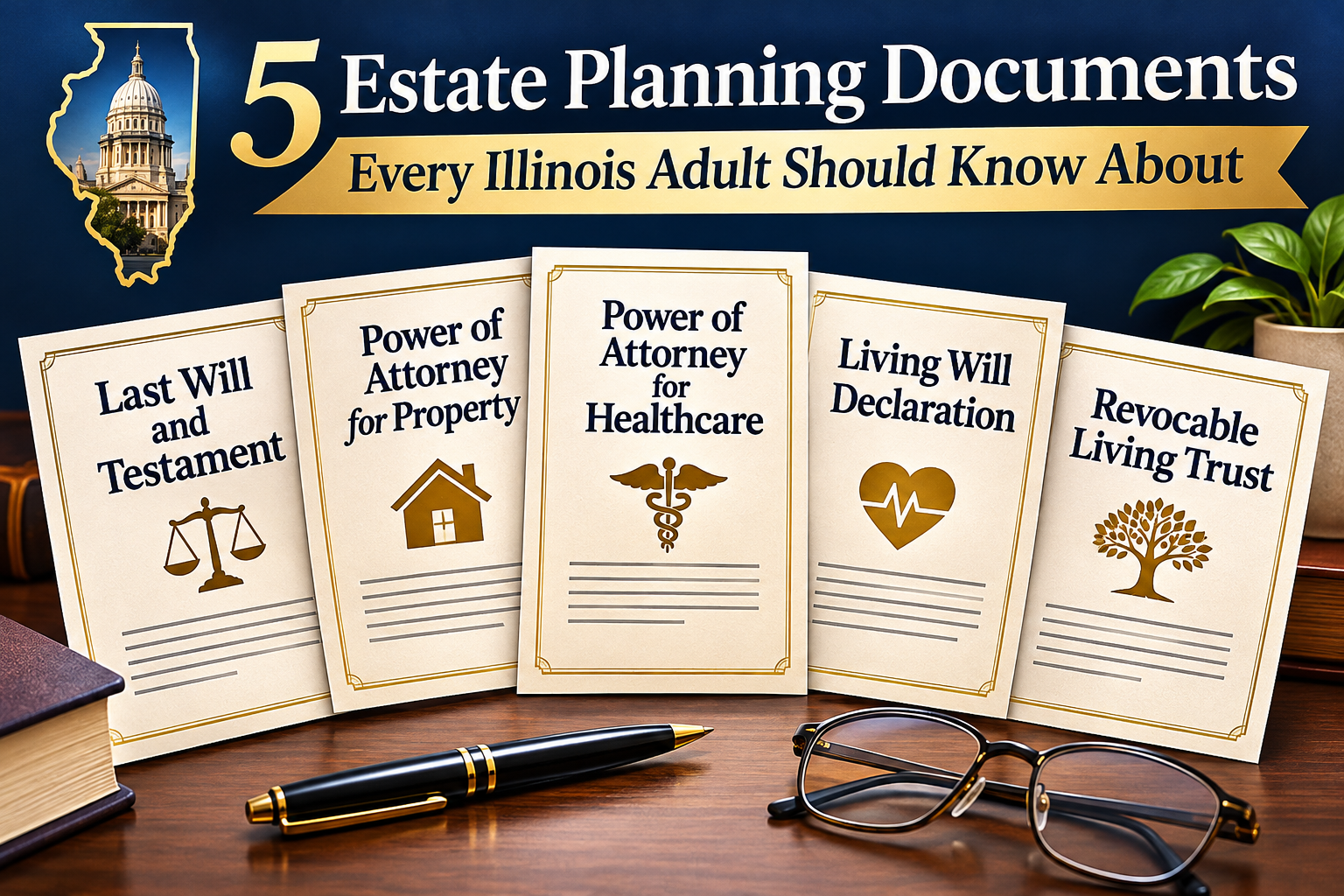
Here are five important documents Illinois adults should understand.
1. Last Will and Testament
A will allows you to express your wishes regarding how certain property should be distributed after your death.
It can also identify the person you want to administer your estate and nominate a guardian for minor children.
Without a valid will, Illinois intestacy laws generally determine who inherits property that would otherwise pass under a will.
However, as we discussed in Article #2,
having a will does not automatically avoid probate.
2. Power of Attorney for Property
What would happen if you were hospitalized and unable to manage your financial affairs?
An Illinois Power of Attorney for Property allows you to appoint someone you trust, called an agent, to handle financial and property matters on your behalf.
Depending on the authority granted, your agent may be able to:
- Pay bills and manage bank accounts.
- Handle financial transactions.
- Manage real estate matters.
- Address insurance and other financial responsibilities.
A property power of attorney can be effective while you're still capable of making decisions, depending on how it is written.
3. Power of Attorney for Healthcare
Imagine being involved in a serious accident and being unable to communicate with your doctors.
Who would make medical decisions for you?
An Illinois Power of Attorney for Healthcare allows you to appoint a trusted person to make healthcare decisions on your behalf when authorized under the document.
Your agent may help make decisions about medical treatment, healthcare providers, and other important matters.
This document is especially important because the person you would want making those decisions might not be the person automatically authorized under Illinois law.
4. Living Will Declaration
A living will is different from a traditional will.
Rather than addressing property after death, an Illinois Living Will Declaration expresses your wishes regarding certain death-delaying medical procedures if you have a terminal condition and cannot communicate your decisions.
For example, it can communicate your desire not to have medical procedures used solely to prolong the dying process under the circumstances specified by Illinois law.
A living will does not replace a healthcare power of attorney. The two documents serve different purposes and may complement one another.
5. Revocable Living Trust
A revocable living trust is an estate-planning arrangement that allows assets to be held and managed under the terms of a trust.
During your lifetime, you may retain control over assets placed in the trust, depending on how it is structured.
After your death, a successor trustee can manage and distribute trust assets according to your instructions.
One potential advantage is that assets properly transferred into a living trust may avoid probate.
However, simply creating a trust does not automatically place your property into it.
Trusts can involve additional costs and responsibilities and aren't necessary for everyone.
Are Witnesses or Notarization Required?
One important detail that's often overlooked in estate planning is that not all legal documents have the same signing requirements.
In Illinois, some estate-planning documents require witnesses, some require notarization, and others have different requirements depending on the document and its purpose.
For example, a Last Will and Testament generally requires two credible witnesses but does not require notarization to be legally valid. An Illinois statutory Power of Attorney for Property generally requires both a qualified witness and notarization, while a statutory Power of Attorney for Healthcare requires a qualified witness but not notarization. Notarization of the healthcare power of attorney is optional and does not replace the required witness.
An Illinois Living Will Declaration generally requires two qualified witnesses but does not require notarization. Trust documents may have different requirements depending on their provisions and the assets involved.
Do you need an attorney to prepare these documents?
Not necessarily. Illinois residents can obtain certain estate-planning forms through online services and other resources. For individuals with straightforward needs, these options may provide an affordable starting point.
However, it's important to understand that downloading or completing a document doesn't automatically make it legally effective. The document must comply with applicable Illinois law, including any requirements for signing, witnesses, and notarization.
More complicated circumstances—such as blended families, substantial assets, business ownership, or special-needs planning—may benefit from professional legal guidance.
The bottom line: Whether your estate-planning documents are prepared online or with professional assistance, understanding the requirements for properly executing them is essential.
Why These Documents Matter
Consider a married couple who has prepared wills but never completed powers of attorney.
If one spouse becomes incapacitated, the other spouse may discover that being married doesn't automatically provide authority to handle every financial or medical decision.
Depending on the circumstances, additional legal procedures might be necessary.
This illustrates why estate planning should consider both
what happens during your lifetime and what happens after your death.
The Bottom Line
Estate planning isn't reserved for wealthy individuals or senior citizens.
Unexpected illnesses and accidents can happen at any age.
Understanding these five documents is a good starting point for discussing your wishes with your family and exploring the estate-planning options available to you.
The best time to think about important decisions is before someone else is forced to make them for you.
Coming next in our Illinois Estate Planning Series: Article #5 — "What Happens to Your Home, Bank Accounts, and Life Insurance When You Die?"
Disclaimer: I am a commissioned Illinois Notary Public, not an attorney. This article is provided for general educational and informational purposes based on research of Illinois law. It does not constitute legal advice. Estate-planning requirements vary depending on individual circumstances, and laws may change. Individuals with questions about their legal rights or the suitability of particular documents should seek guidance from a qualified Illinois attorney.